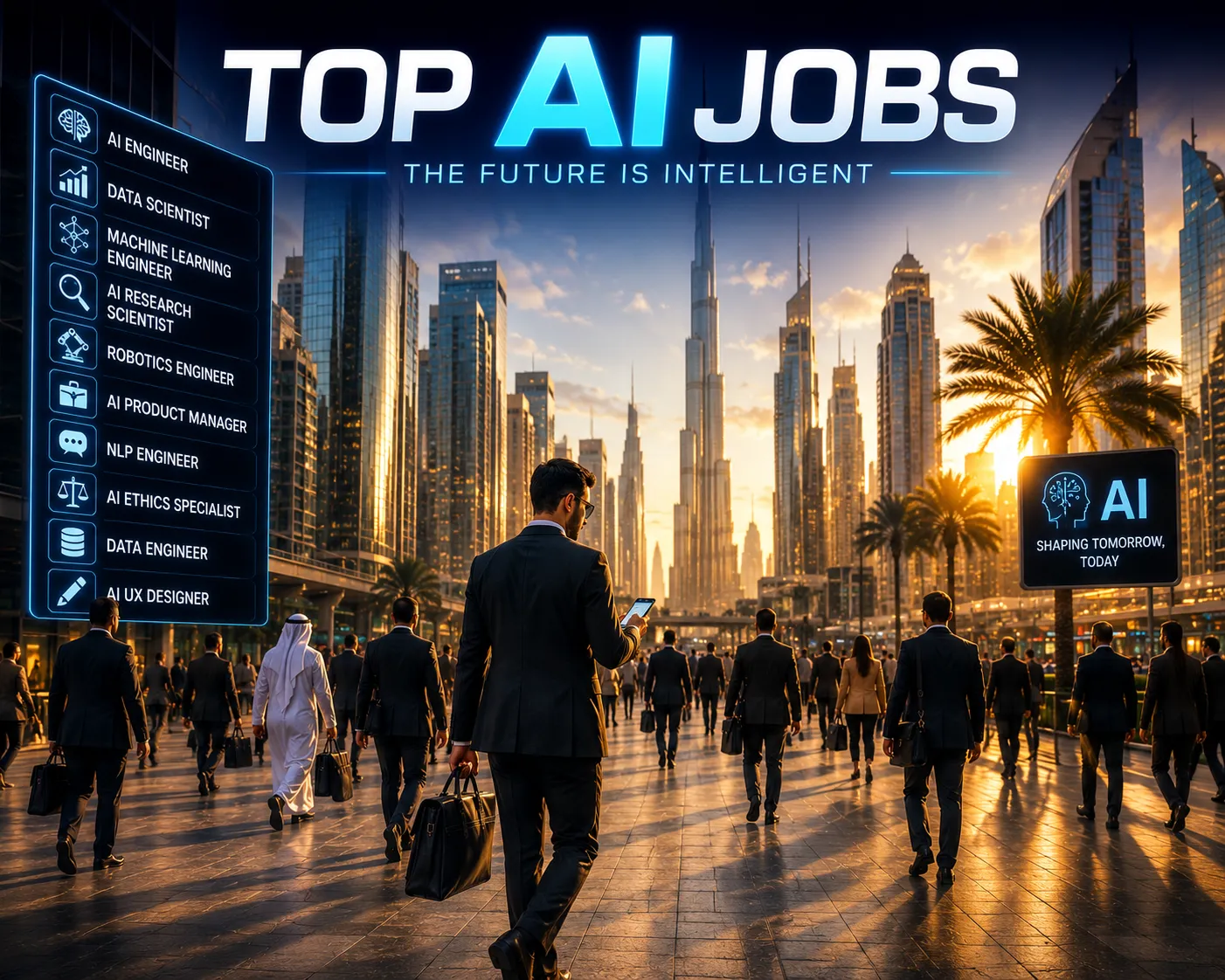
AI is no longer a department — it's a layer running through every department. That's why the hiring market for AI talent doesn't look like one job category anymore, it looks like sixteen. And the numbers back up how fast this has moved: LinkedIn's 2026 Jobs on the Rise report ranked AI Engineer as the #1 fastest-growing job title in the United States, with postings up 143% year-over-year, and four of LinkedIn's top five fastest-growing roles overall are AI-related. Industry-wide, AI, ML, and data science job postings grew roughly 163% between 2024 and 2025, and by January 2026 there were more than 275,000 active postings referencing AI skills. Here's a tour of the roles actually driving that growth, grouped by what they're really for.
The builders: technical AI roles
AI Engineer has become the umbrella title for anyone who designs, builds, and ships AI-powered systems — less "researcher in a lab," more "engineer who makes AI actually work in production." It's currently the single most-posted AI job title in the country. MLOps Leads take over from there, keeping deployed models reliable, monitored, and retrained as data drifts — a specialization that reportedly commands a 25–40% pay premium over general ML roles. AI Solutions Architects sit closer to the business side, figuring out which AI approach actually fits a company's problem instead of chasing whatever's trending. A newer title, AI Agent Architect, has emerged specifically for people who design multi-step autonomous agents — deciding where a human needs to stay in the loop and where the agent can be trusted to run on its own. Rounding out the technical core, AI Researchers are still the ones pushing the underlying science forward, whether inside a lab or an applied research team at a product company.
The guardians: security and governance roles
As AI systems handle more sensitive decisions, a parallel set of roles has grown around keeping them safe and accountable. AI Security and Red Teaming Specialists act like ethical hackers for models — probing for prompt injection, data leakage, and manipulation before someone with worse intentions finds it first. AI Ethics and Compliance Officers handle the policy side: bias audits, data privacy, and navigating a regulatory landscape that's shifting under everyone's feet. AI Data Governance Managers own the less glamorous but equally critical layer underneath all of it — making sure the data feeding these systems is clean, accessible to the right people, and compliant with the law.
The communicators: creative and marketing roles
AI changed how content gets made, and a set of roles emerged to steer that shift instead of being replaced by it. GEO/AEO Specialists (generative and answer-engine optimization) are the modern evolution of SEO, focused on how a brand gets surfaced and cited inside AI-generated answers rather than traditional search results — a genuinely new discipline that barely existed three years ago. Conversational AI Designers script the personality and flow of chatbots and voice assistants, blending UX design with actual writing craft. AI Creative Directors lead teams that use AI tools throughout production without losing a distinct creative point of view, and AI Content Strategists — one of LinkedIn's other fast-rising titles — decide how a brand uses generative tools at scale while keeping quality and voice consistent.
The steerers: leadership and enablement roles
AI Product Managers own the full lifecycle of AI-powered products, closing the gap between what a model can technically do and what actually solves a customer's problem. AI Strategists and AI Automation Consultants — another role LinkedIn flagged among its fastest-growing — zoom out further, helping leadership figure out where AI investment will actually pay off versus where it's just noise. AI Enablement and Literacy Leads handle the unglamorous but essential work of getting an entire organization comfortable and competent with new tools. And at the top, a small but growing number of Chief AI Officers now own enterprise-wide AI strategy and accountability, often starting as a fractional or part-time role before becoming permanent.
An emerging category worth watching: sector-specific AI roles
One of the more interesting shifts in 2026 is how fast AI roles are appearing inside industries that aren't traditionally "tech" at all. Healthcare AI Integrators, for example, have become essential as hospitals and health systems adopt AI tools for diagnostics, scheduling, and administrative work — these roles need people who understand clinical workflows first and AI second, which is exactly why they're hard to fill and pay well.
What all of this pays
The wage data backs up the demand. PwC's 2025 analysis found that roles requiring AI skills carry a 56% wage premium over comparable non-AI positions — more than double the 25% premium measured just a year earlier. That premium shows up clearly at the technical end: machine learning engineer compensation commonly clusters between $155,000 and $200,000 at the mid-level, climbing well past $260,000 in total compensation for senior engineers at top employers, with generative AI and LLM specialization adding another 40–60% on top of baseline ML pay.
What this means if you're job hunting
None of these sixteen titles require the same background. Some are deeply technical, others are almost entirely about policy, communication, or strategy. The common thread is that all of them require enough AI fluency to be credible in the room — which means the fastest way into any of them is hands-on experience with the tools themselves, not a title change on your resume.
Sources: HeroHunt's 2026 AI role rankings, Robert Half's 2026 technology hiring research, and Kore1's AI Engineer salary guide.